Patch repairs on rented homes
When a patch repair is enough on an occupied rental
A rented house with a cracked or blown patch of render does not always need the whole wall redone. A well-made patch repair, with the cause put right, can be the proportionate fix. This article explains how to tell a patch job from a re-render, what the repair involves on the day, how to fix the cause and how to keep a useful record.

On this page
Is it a patch job?
A limited repair suits damage that is confined: a crack from the corner of one window, a hand-sized patch that sounds hollow, or a corner knocked off by a bin or a car. Tap the render around the damage from ground level with a knuckle or the handle of a screwdriver; where the sound stays solid a short distance from the defect, a patch is realistic.
If the dull, drummy sound carries on across the wall, the render has lost its bond widely and patches will keep chasing the problem. Cracks branching across a whole elevation, bulges and render coming away in sheets point the same way. Those are re-render jobs, however small the first visible defect.
The resident's part is simple: report what they see, where and when it started, with a photo from the ground if they can. Testing high render, picking at loose pieces or climbing to look is not their job, and loose render above a door or path should be made safe by the landlord's contractor.
| What you see | Usual next step |
|---|---|
| One crack from a window corner | Patch with mesh across the corner |
| A hand-sized hollow area | Cut back to sound render and patch |
| Hollow sound across much of the wall | Strip and re-render |
| Crumbling render at the base | Cut back above a bell-cast bead |
| Stain under a sill or gutter | Fix the water source, then patch |
Repair first, then decide on colour
On a painted render, a patch shows as a different texture and shade until the wall is recoated. A wider colour treatment, two coats of masonry coating over the whole elevation once the repair has cured, makes the patch disappear and refreshes the front at the same time.
On a through-coloured render, such as monocouche or silicone, there is no paint to unify the wall. The patch is made with the same system's materials and textured to match, and it will still look fresher than the weathered render around it for some time. Agree in advance whether that is acceptable or whether the face will be recoated.
For example, on a hypothetical rented semi with cream painted render and a cracked corner beside the front door, the landlord could choose a patch only, accepting a visible repair, or a patch followed by a recoat of the front. The second means another stage of work but leaves no visible mark; the first is quicker.

What happens on the day of a patch repair
A patch repair on a rented house is normally done from outside, with a tower or a short scaffold for anything above ground floor. The occupier will notice noise while the render is cut out, dust near the work, and a window or door on that side that may need to stay shut. If loose render is above a doorway or path, that area is fenced off until the repair is done.
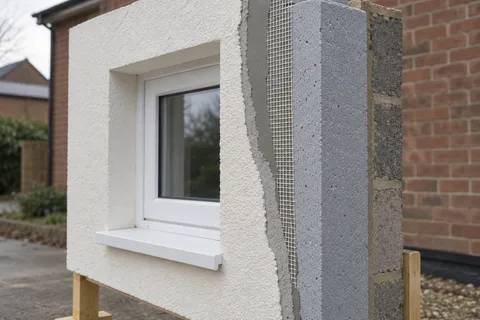
The Leeds rendering and repair guide explains where a patch ends and a re-render begins. On the day, the repair itself follows a simple order: cut back to sound render, repair the wall behind, rebuild in coats and finish to match.
Make any loose render safe and fence off the area below.
Find and fix the source of water, such as a gutter, downpipe or sill.
Tap round the defect and mark out sound render.
Cut the patch back to clean, square edges.
Repair the masonry and dampen or prime the backing.
Rebuild the render in matching coats, with mesh across crack lines.
Finish the texture and, if the wall is painted, recoat it once cured.
Fixing the cause as well as the render
Most local failures have a reason. A blown patch under a gutter outlet, a crack that starts at a window corner, crumbling render at the foot of the front wall or a stain below a sill each point to a specific cause, and the SPAB stresses that defective rainwater fittings concentrate wetting on walls. If the gutter leaks or the sill does not throw water clear, the new patch will fail in the same place.
So the repair scope should name the cause and how it is being dealt with. For example, on a hypothetical rented through-terrace, render at the base of the front wall is crumbling where it runs down onto the pavement. The fix is to cut it back above the damp-proof course and finish on a bell-cast bead, which Catnic describes as letting water drain clear of the wall below, rather than patching the same material back to the ground.
Some causes belong to another trade. A cracked downpipe, a roof leak or a failed flashing may sit outside the render repair, but it still needs arranging and putting in the right order.
Timing matters in winter. Render patches should not go on in frost or onto a frozen wall, and a repair made just before a hard frost can lose its bond. If a defect is reported in cold weather, the loose material can be made safe straight away and the permanent repair scheduled for a milder spell.
Matching, recording and follow-up
A fresh patch will usually look different from the aged render around it, at least for a while. On a painted render, the cleanest result comes from repairing first and then recoating the whole elevation; Structherm's masonry paint instructions, for example, say all repairs should be completed before the coating goes on. On through-coloured render, agree in advance whether a visible patch is acceptable or whether the face will be recoated.
Keep a short record for the property file: where the repair was, what was found behind the render, what material was used, what caused the failure and what was done about it. Add before-and-after photos from the same viewpoint. If another report comes in, that record shows quickly whether it is the same problem returning or a new one.
Tell the occupier when the work is finished, when any fenced area can be used again and how to report anything new, such as fresh cracks, render falling or damp appearing on the same wall. Residents should not be asked to judge whether a crack is serious; they just need a simple way to report it.
Common questions
Who should arrange access when a tenant is in?
The landlord or managing agent, using the tenancy's normal notice arrangements. The contractor needs to know which entrances and windows are affected and who to call on the day.
Is a patch enough if the render is hollow nearby?
Not if hollow render spreads well beyond the visible defect. A tap test round the area shows whether the patch is a true repair or the first of many.
See housing and planning information for Leeds and nearby places, including the source and geography behind each figure.