Silicone rendering
Silicone rendering in Leeds
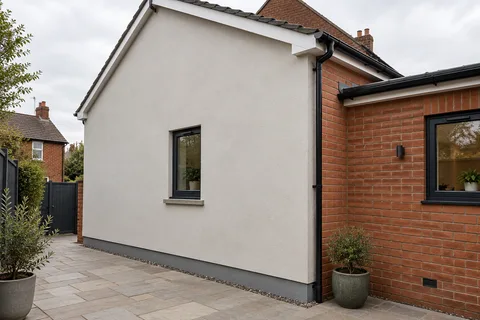
Silicone render is a ready-mixed, through-coloured topcoat made with silicone and acrylic resins. It goes on very thin, only as thick as its largest grain, over a base coat and primer that do the real work of levelling and reinforcing the wall. The finish repels rain well, comes in a wide colour range and keeps a fine, even texture, which makes it a good fit for extensions, re-rendered semis and insulated walls.

On this page
The layers, from wall to finish
Structherm's data sheets describe a typical build-up. The topcoat, Struc-Sil, is a cement-free resin render in 1.0mm, 1.5mm or 3.0mm grain sizes, applied with a stainless-steel float to the thickness of the largest grain and then rubbed up with a plastic float to create the texture. Beneath it goes a primer, Primer TC, matched to the finish colour and left 24 hours. Beneath that is a base coat, and Structherm wants a newly applied base coat to stand for 14 days or more before topcoat work starts.
The base coat carries the mesh. In Structherm's thin-coat insulation system, for example, a first 2–3mm layer of polymer-modified base render goes on, glass-fibre mesh is pressed into it, and a second layer brings the total to 4–6mm. On masonry the principle is the same: mesh across the whole face, with extra pieces set diagonally at the corners of windows and doors where cracks usually start.
Prepare the wall: strip failed render, repair masonry, dub out hollows.
Fix the beads: bell-cast above the DPC, stop beads at brick, corner beads on angles.
Apply the base coat in two passes with glass-fibre mesh bedded between them.
Leave the base coat to cure for the period the system requires.
Apply the tinted primer and allow it to dry.
Float on the topcoat, rub it up to texture and finish each elevation without stopping.
Keep rain, strong sun and wind off the fresh finish until it has set.
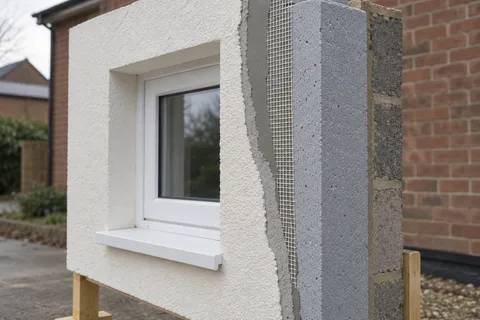
- Sound background A background accepted by the specified system. Keeping old render requires a system-specific assessment of its bond and condition.
- Beads Corner, stop and base beads set the edges and straight lines.
- Basecoat with mesh Glass-fibre mesh embedded in the basecoat resists cracking.
- Primer Where the system requires it, tinted towards the finish colour.
- Silicone finish A thin, through-coloured, water-repellent coat that forms the texture.
Wall on the left, finish on the right. Not to scale: coats, thicknesses and primers follow the chosen manufacturer’s system and the condition of the wall.
Good uses, and walls to avoid
Silicone suits new blockwork, brick that has been given a proper base coat, old render that has been stripped or proven sound and re-based, and insulation boards. It gives a crisp result on an extension beside a brick house, where the colour can be chosen to sit with the brick rather than copy it. Because the finish is so thin, it will not hide a hollow or cracked background; anything wrong beneath shows through or pushes it off.
It is the wrong choice on old stone or lime-rendered walls that need to dry out through their face. The SPAB warns that rigid, impermeable coverings can trap moisture in old walls, and the Headingley Hill conservation area appraisal says the rendering of stone walls should be avoided there. A stone-fronted Leeds terrace is a job for stone repair or lime, not a resin topcoat.
What goes wrong with silicone
Most faults are workmanship and weather. Stop a topcoat partway along a wall and the join shows, so every elevation is completed in a single push. Structherm says the substrate and air should be at least 5°C, and not to apply in strong sunshine or wind or onto damp or frozen backgrounds. Its base coat guidance adds that downpipes, sills and scaffolding must not throw water onto setting render and that fresh render needs at least 48 hours' rain protection, which on a Leeds terrace front can mean sheeting the scaffold.
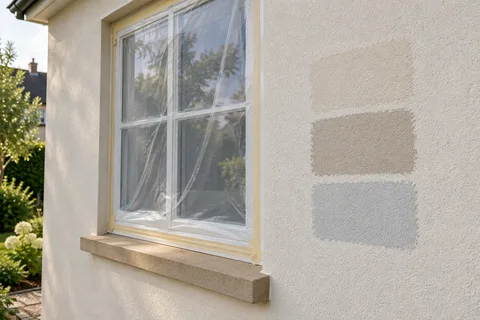
Edges matter as much as the field. Sills have to project beyond the new face with a drip; stop beads need sealing where they meet brick; the bottom edge should sit on a bell-cast bead above the DPC. Masking is essential, because primer and topcoat stain uPVC, glass and brick, and on a terrace that includes the neighbour's frontage.
Care after it is finished
Structherm says its topcoat contains a biocide against moulds, yeasts and algae and has low susceptibility to soiling. That helps, but shaded and north-facing walls, or walls under dripping trees and leaking gutters, can still discolour. Clean gently with a product made for the finish rather than a high-pressure jet. Keep the product name, grain size and colour reference so a later repair or a new opening can be matched.
Common questions
Why is the grain size part of the choice?
The grain sets both the texture and the thickness of the topcoat. A 1.0mm grain is finer and smoother looking; a 3.0mm grain is coarser and hides minor unevenness better.
Can silicone go straight onto brick?
Not as a single coat. Brick needs a base coat with mesh first, then primer, then the silicone topcoat.
See housing and planning information for Leeds and nearby places, including the source and geography behind each figure.