Pebbledash removal and re-rendering
Pebbledash removal and re-rendering in Leeds
Pebbledash is a cement render with small stones thrown into its surface while it is wet. It wears well for a long time, but once it cracks or loses its grip on the wall, water gets behind it and it starts to drum and drop. Removing it is noisy and dusty, and it is only the first half of the job: the wall underneath almost always needs repairing and re-rendering.

On this page
What you are dealing with
Pebbledash is part of the mix in parts of Leeds. The Morley conservation area appraisal, for example, notes pebbledash render on a number of early twentieth-century houses in an area otherwise built mainly of local sandstone and red brick. A dashed finish is usually two or more layers: a base coat on the brick or block, then a dash receiver into which the stones are thrown. Structherm's data sheet describes its dash receiver as a 6–8mm coat, with washed aggregate thrown on while it is still plastic and tamped in with a wood float.
The tell-tale signs of failure are a hollow sound when tapped, cracks that follow brick courses or run from window corners, bulging areas, stones dropping onto the path and patches where earlier repairs never matched. Damp patches inside behind a dashed wall are a further sign that water is getting through cracks and being held in the masonry.
- Trial area A small patch is taken off to see how well the dash is bonded and what lies beneath.
- Removal Dash and backing render are hacked off to masonry or to a sound backing coat.
- Clear and dispose Debris is bagged or skipped; this is heavy, dusty and noisy work.
- Repair the masonry Exposed bricks, blocks and joints are repaired before anything new goes on.
- New render system The wall is rendered with the chosen system, or left as fair-faced masonry if suitable.
The usual order of work. The survey and the chosen products decide the actual steps.
Does it have to come off?
Not always. If the dash sounds solid across the wall and the only problem is a tired colour, it can be cleaned and coated; Structherm lists pebble-dashing as a suitable surface for its silicone masonry paint once repairs are done and the wall is clean and dry. If the bond is sound but you want a new texture, an overcoat can go over it, and Structherm makes an overcoating dash specifically for refurbishing existing dry dash.
Removal is the answer when hollow areas are widespread, when cracks are letting water in, or when you want a smooth or thin-coat finish that needs a flat, sound background. For example, on a hypothetical 1930s semi where the front bay and the side wall both drum when tapped, patching would leave more old dash than sound dash, and stripping those faces is the realistic option.
Stripping and rebuilding the wall
On a terrace or semi, the route for the rubble matters as much as the stripping. Old dash is heavy, and at the back of a through-terrace it may have to be bagged and carried through a passage or yard. Where a skip or materials have to stand on the road or pavement, Leeds City Council permission is needed, so allow for that before the work is booked.
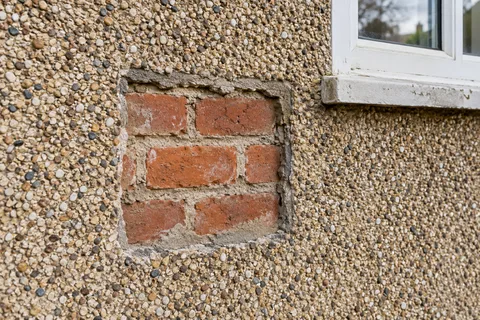
Behind the dash there is often brick that was never meant to be seen: mixed colours, old doorways and windows bricked up, soft joints and faces damaged by the removal itself. That is why bare brick is rarely the result. A meshed base coat bridges the patchwork, and then a silicone, scraped or painted finish goes on. If you want to see the brick, a trial patch is the only way to find out whether it is presentable.
Tap-test every face and cut a small trial area to see how the dash and backing come away.
Protect windows, doors, paths and the neighbour's side, and plan the debris route.
Hack off the dash and its backing coat with a bolster or light breaker.
Brush down, rake out failed joints and replace damaged brick.
Dub out hollows and fill old openings so the wall is even.
Fix beads and apply a base coat with mesh, reinforcing every opening corner.
Apply the new finish and protect it while it cures.
Permission and building regulations
In one of Leeds's 80 conservation areas, changing dash to a visibly different finish needs a planning check. Do not treat it as like-for-like repair; new render cladding is outside householder permitted development rights. Approved Document L also treats stripping to masonry and replacing the render as renovation, and beyond half of the wall or more than a quarter of the envelope the wall may have to be insulated where that is workable. Raise it with building control early: insulating a wall that is already bare is far easier than coming back later.
Common questions
Does a small trial prove the entire elevation will strip cleanly?
No. It shows how the dash behaves at that spot. Other areas may be better or worse bonded, so the trial is read together with a tap test of the whole wall.
How messy is pebbledash removal?
Very. Expect dust, rubble and noise for the stripping days, and keep windows closed. Good sheeting and a clear debris route make a big difference.
See housing and planning information for Leeds and nearby places, including the source and geography behind each figure.