Render colour changes and resprays
Render colour changes and resprays in Leeds
A respray puts a new masonry coating over render that is still well bonded, changing its colour without stripping anything. On a Leeds house where the render is sound but faded, stained or simply the wrong colour beside new windows, it is the least disruptive way to change the look. It cannot fix hollow or cracked render, so the wall is checked before any paint is bought.

On this page
Checking the surface first
Tap the render all over. Drummy patches mean loose render that a coating will not hold on, so those are cut out and repaired first. Note any crack broader than a hair, paint lifting in flakes, white salt bloom and patches of green or black growth. A coating can only be as sound as its base, and Structherm's silicone masonry paint sheet sets the bar: fully cured, dry and level, with no efflorescence, crumbling material, algae or dust, and every repair finished beforehand.
Check what the render is. Previously painted sand-and-cement render is the usual case. A lime render should not get a standard masonry paint; the SPAB recommends limewash and does not recommend modern paints on lime. Monocouche and silicone finishes can take a coating too, provided its manufacturer accepts them as a base.
Coatings differ as well. Acrylic, silicone and mineral silicate paints behave differently on render. A silicone masonry paint such as Struc-Sil is classed by Structherm as highly vapour-permeable with low water absorption, which suits a render that needs to shed rain but still dry out. Whatever the type, it has to suit the existing coating as well as the render, so an unknown old paint may need testing or removal first.
- Clean Washed down, with algae and mould treated and left to work.
- Repair first Cracks and hollow patches are repaired before any coating.
- Prime or stabilise Where the coating maker requires it on that surface.
- Coating Usually two coats of a breathable masonry or silicone coating.
The usual order of work. The survey and the chosen products decide the actual steps.
From cleaning to second coat
Cleaning and masking take longer than the painting. Any growth painted over will discolour the new finish, which is why Structherm calls for its algae cleaner before the paint goes on. On a terrace, the masking includes the neighbour's brick and windows at the party line, and spraying needs calm weather so the mist does not drift onto cars on the street.
Most coatings are two coats. In Structherm's method the first coat is let down with as much as a tenth water, the second goes on neat after an interval of roughly 8–12 hours, and the paint is used only while temperatures stay between 5°C and 30°C. Whole elevations and adjoining panels should come from the same batch so the colour does not shift partway along the wall.
Repair any loose or cracked render first and give the patches time to harden.
Treat moss, lichen and algae with a biocide, then rinse the wall down gently.
Mask frames, glass, sills, brick, stone and paving, and the neighbour's side on a terrace.
Prime or stabilise if the coating system calls for it.
Lay on the first, slightly thinned coat and leave it until completely dry.
Roll or spray the full-strength second coat over each elevation in one continuous run.
Strip the masking and touch in the edges.
Choosing a colour beside brick and stone
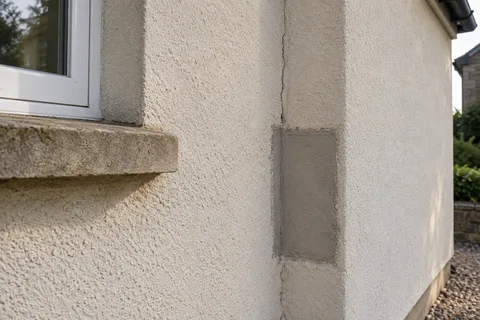
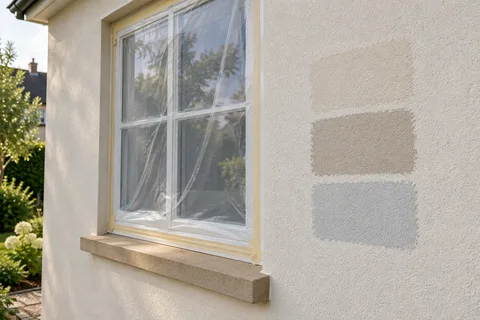
Where the render sits beside red brick or sandstone, the colour has to work with that masonry, with the roof and with the window frames. Try the colour as a trial square on the render itself rather than on a card, and look at it from the street in morning and late-afternoon light. Pale colours brighten a shaded terrace but show dirt below sills; darker colours hide dirt but can make a narrow street front feel heavy. Settle early whether reveals, the plinth and the door surround follow the main colour or a contrasting one.
If new windows are planned, choose the render colour against the new frames, not the old ones, or schedule the respray after the windows go in.
Permissions and keeping it fresh
Repainting an already-painted render is usually straightforward, but a listed building or a house covered by an Article 4 direction may need consent for a change of colour, so check with Leeds City Council if either might apply. Afterwards, keep the product, colour reference and batch number. Clean the wall gently when it dulls, and recoat when the finish starts to chalk or fade.
Common questions
Can I approve a colour from a phone image?
Use photos for ideas only. Screens and cameras change colour, so approve a real sample painted on the wall and seen in daylight.
Can pebbledash be resprayed?
Yes, if it is firmly bonded. Some masonry coatings list pebble-dashing as a suitable surface, but the rough texture needs more paint and more care to cover evenly.
See housing and planning information for Leeds and nearby places, including the source and geography behind each figure.