Lime rendering
Lime rendering in Leeds
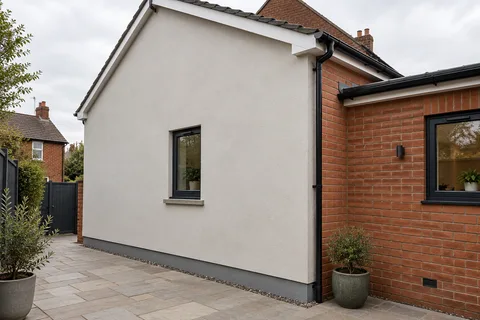
Lime render is a soft, permeable covering that lets solid old walls dry out through their face. It is the right material for repairing an existing lime render, for re-covering a wall that has lost a failed cement render, and for older cottages and outbuildings that were meant to be rendered. It is not a reason to render stone that was built to be seen.

On this page
First question: should this wall be rendered at all?
Much of older Leeds is stone. Council appraisals describe local sandstone and red brick as the main materials in Morley, and stone villas and terraces in Headingley Hill, where the appraisal advises against rendering stone walls. Leeds has 80 conservation areas, where adding render to bare masonry needs planning permission. Repairing an existing finish without materially changing its appearance is different. On a coursed sandstone front, the usual repair is to the stone and its pointing, not a new covering.
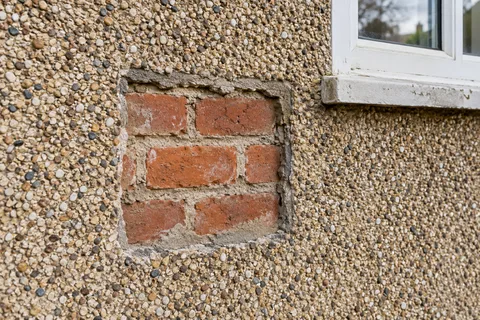
Lime render comes in when a wall was rendered before, or when a cement render has failed and is trapping water. The SPAB explains that rigid Portland cement renders form hairline cracks because they are harder than the wall, and those cracks draw in water that cannot then escape. That is the situation where stripping the cement and re-rendering in lime makes most sense.
- Stone or brick masonry Cleaned of loose material and dampened so it does not draw water out too fast.
- First (scratch) coat Often haired; scratched to give the next coat a key.
- Second (floating) coat Applied once the first has firmed up; follows the line of the wall.
- Finish coat Thin final coat, kept damp and shaded while it cures.
- Limewash or mineral paint Optional decoration that keeps the wall permeable.
Wall on the left, finish on the right. Not to scale: coats, thicknesses and primers follow the chosen manufacturer’s system and the condition of the wall.
Removing cement render without wrecking the wall
The SPAB urges great care here: prising cement off in big slabs can badly damage the soft material underneath, so a small test area is taken off first. That test reveals whether the cement comes away cleanly or takes the stone face with it, what condition the joints are in and how wet the wall is. A soaked wall may need a short drying-out pause, the SPAB suggests, and any decayed backing must be repaired before re-rendering. Gutters, downpipes and ground levels are checked at the same time, because a render will not cure a wall that is being soaked from above or below.
Building a lime render up
Lime goes on in two or three coats, each no thicker than the one beneath. Ironstone's NHL 3.5 basecoat is one example: its guide specifies a first coat of 10–12mm, combed in a criss-cross pattern roughly a third deep and left for a week, then a second coat of 8–10mm. Lime is worked with the float once it has firmed up, not while it still drags, which feels different from cement. Other lime products and site-mixed lime have their own timings.
Suction control matters on old masonry, which can vary from one course to the next. Wetting the wall before each coat stops thirsty masonry drawing the moisture from the lime and leaving a weak, powdery layer.
Remove a trial area of old render, then the rest, with hand tools where the backing is soft.
Rake out decayed joints and let a wet wall dry.
Fill deep voids and dub out hollows with a stiff lime mix, kept damp.
Damp the wall to control suction, then apply the first coat and scratch it.
Keep the first coat damp and shaded while it firms.
Apply the second coat no thicker than the first and float it when stiff.
Cure slowly, then finish with limewash.
Curing, finishing and keeping it right
Fresh lime is easily spoiled by sun, wind and frost. Ironstone asks for the render to be kept damp with a mist spray, shaded from sun and wind, ideally under damp hessian, and applied only between 5°C and 30°C. That usually means sheeted scaffolds and a season that avoids frost.
The finish has to stay breathable. Limewash is the SPAB's recommended finish; it advises against ordinary modern paints and clear water-repellent treatments on lime. Approved Document L takes the same line, allowing energy upgrades to traditional stone or lime walls only where the fabric will not deteriorate over time. Defects are cut out and patched in a matching lime, never in cement.
Common questions
Can a later extension be assessed separately from an older frontage?
Yes. A modern blockwork extension can take a modern render, while the original stone or lime-rendered wall keeps a breathable treatment. The junction between them needs a designed stop.
Is lime render slower than cement?
Yes. Each coat needs days to gain strength and careful curing, so a lime job runs at the pace of the material and the weather.
What does a finished lime render look like?
Softer and less uniform than a modern render, with gentle undulations that follow the wall, usually limewashed. Ironstone's guide notes that the float coat can be sponged once it has stiffened to give a smoother surface where it is the final coat.
See housing and planning information for Leeds and nearby places, including the source and geography behind each figure.