Wall rendering
Wall rendering in Leeds
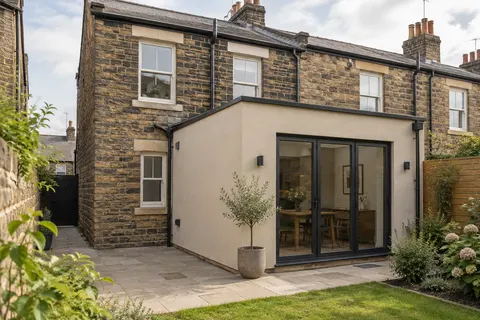
Not every job is a whole house. Often it is one wall: the gable of an end-terrace that takes the wind, the side of a semi, the blockwork of a new extension, or a yard wall behind a through-terrace. Rendering a single wall uses the same layers as a full re-render, but the stopping edges, the junction with the walls that stay and the access to that one face decide how good the result is.

On this page
Typical one-wall jobs
A gable end is the classic case. It is usually the most exposed wall, it may never have been designed to be seen, and it often carries decades of patched pointing. Rendering it in a breathable, well-detailed system can keep the weather off. A semi's side wall is similar, with the added complication of a path or drive below and a neighbour's fence close by. On a new extension, the blockwork needs a finish before it can be left, and the render has to meet the original house neatly.
Before committing, tap-test the wall and the first metre or so of the walls around it. If hollow render continues round the corner onto the front, stopping exactly at the corner leaves a weak edge next to new work. And if the wall is stone and sits in a conservation area such as Headingley Hill, whose appraisal says rendering of stone walls should be avoided, the right repair may be repointing rather than render.
- Set the edges Decide where new render stops against brick, stone or an existing finish.
- Prepare the background Remove loose material, repair masonry and prepare suction and surface key. Existing paint needs a specified removal or alternative treatment.
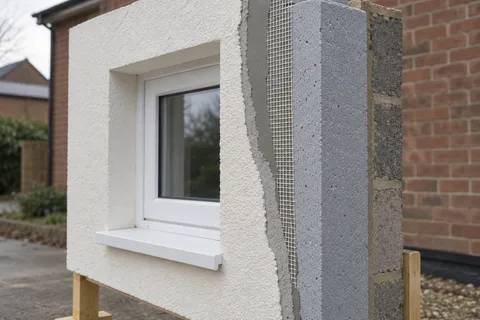
- Base coat Built up to level the wall, with mesh where backgrounds change or crack.
- Finish Matched to the rest of the house or chosen as a deliberate contrast.
- Shed the water Copings, sills and the base bead keep rain off the top and away from the bottom edge.
The usual order of work. The survey and the chosen products decide the actual steps.
The sequence for one wall
Access often costs more effort than the wall itself. A gable above a neighbour's single-storey extension, a side wall beside a narrow drive or a wall facing the pavement each needs a different arrangement, and in Leeds anything placed on the road or pavement needs council permission.
A thin-coat finish has to be worked to a wet edge, so the whole wall is finished in one session once started. Structherm's silicone topcoat instructions ask for continuous surfaces to be completed without interruption, which means having enough hands on the scaffold for the size of the wall.
Photograph the wall from both ends and from the street, including whatever sits below it.
Arrange access: tower, scaffold or, on a pavement frontage, a highway licence.
Strip or prepare the face and repair the masonry.
Fix stop beads where the render meets brick or stone that stays, and a bell-cast bead above the DPC.
Apply the base coat and mesh, then the finish in one continuous session.
Seal the stop beads, check the verge and sill details and clear the site.
Stopping cleanly and keeping water out
The visible edges are where single-wall jobs fail. Against brick or stone that is staying, the render should finish on a stop bead, which leaves a crisp line ready for sealant instead of a thin feathered edge that cracks off. At the base, a bell-cast bead above the DPC throws water clear of the masonry below; Catnic describes its bell-cast bead for use at DPC level and above or below openings. On a gable, the render finishes neatly under the verge or bargeboard, and on an extension the flashing and the roof junction need checking before the wall is covered.
Thickness is the other edge issue. A new render stands proud of the old face by its full build-up, so a gable rendered beside a brick front leaves a small step at the corner, and window sills on that wall must still project past the new surface with a drip underneath.
Yard and garden walls
A freestanding yard wall is wet from both faces and the top. It needs a coping that overhangs both sides with drips, render on both faces where possible and a clear gap above the ground. If it leans or is cracked through, rebuild it first. Ownership matters: on a terrace, a yard wall may be shared, so agree the work with the neighbour before anyone starts.
Common questions
Can a wall be finished up to the neighbour's boundary?
Yes, with a stop bead at the line and the neighbour's agreement if the scaffold or the work touches their property. The render should not run onto their wall.
Will a rendered gable match the rendered front?
Not exactly at first. Fresh render is brighter than a weathered finish. Either accept the difference, choose a deliberate contrast or recoat the front at the same time.
Will rendering a gable stop damp inside?
Only if the damp comes from rain soaking through that gable. If it comes from a leaking gutter, a failed verge or render bridging the DPC, those have to be fixed; new render over the top will not cure them and can hide them.
See housing and planning information for Leeds and nearby places, including the source and geography behind each figure.