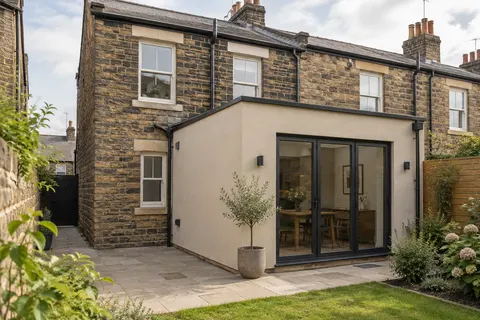
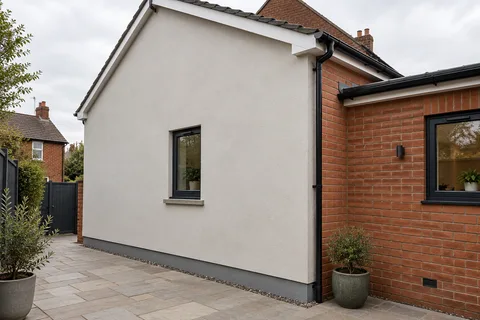
Brick under pebbledash
Will there be good brick under my pebbledash?
Photos of beautiful brick revealed from under pebbledash make removal look like a sure thing. Sometimes it is. More often, the wall behind was built to be covered, has been altered over the years and is damaged by the removal itself. This article explains what is usually found, how to judge it and what the options are when it is not good enough to leave bare.

On this page
Why the brick behind is often disappointing
Removing an unsuitable or failed finish exposes a wall that was built on the assumption that nobody would see it. Brick chosen for strength rather than looks, joints never pointed as a finished face, and repairs made in whatever brick was to hand are all normal behind a dash. Stripping does its own damage too: render bonded hard to the brick can pull the faces off as it comes away.
For example, a hypothetical trial beside a front door might reveal regular brick for a metre, then a block of different brick where a window was once filled in, with a steel lintel above. That one opening shows why a bare-brick finish across the whole front can look patchy even when every brick is sound.
That is why a replacement render stays part of the plan until the brick has been seen over a representative area. If the brick is not good enough to leave bare, the job moves straight on to repair and re-rendering rather than leaving a stripped wall exposed to the weather.
| What the trial shows | What it suggests |
|---|---|
| Render parts cleanly from even brick | Exposed brick may be possible |
| Brick faces come away with the render | Re-rendering is likely |
| Different brick around old openings | A patchy look if left bare |
| Soft, damp or salty brick | Fix the water source; re-render or use lime |
What is usually under the dash
A dashed finish is several layers deep. Structherm's dash receivers, for example, are normally applied onto a base coat, with washed aggregate thrown into a 6–8mm receiver coat while it is still plastic. So between the stones and the brick there may be two or three coats of cement render, each bonded to the next.
Behind them is whatever the builder thought would never be seen. In the Morley conservation area, the council's appraisal notes pebbledash on a number of early twentieth-century houses in a town built mainly of local sandstone and red brick, so the wall could be either. Things that turn up include bricks of mixed colour, rough joints never meant as a finished face, blocked-up doors and windows in a different brick, steel or timber lintels, old fixings and areas patched with cement.


Judging the brick from a trial patch
Ask for a trial removal in a place that tells you something: an ordinary area of wall, plus one near a window or door where alterations are likely. Watch how the render comes off. If it parts cleanly from the brick, faces are likely to survive. If lumps of brick face come away with it, a full strip will leave a scarred wall.
Then look closely at what is revealed. Are the bricks of one colour and size, or a patchwork? Are the joints fairly even and full, or ragged and deep? Is there cement residue welded into the joints and faces? Is there a different brick around an old opening? Do bricks look soft, wet or salty? A wall that passes those checks across a representative patch may be worth exposing; one that fails them is usually re-rendered.
For rendering projects in Leeds, keep removal-only and removal-and-replacement prices separate, and ask what each assumes about the trial. If the brick will not be left bare, the replacement render is part of the job from the start.
If the brick is good enough to keep
Exposed brick after pebbledash still needs work. Render residue is cleaned off carefully by hand; aggressive mechanical or abrasive cleaning can damage brick faces, so any method is tested on a small area first. Damaged bricks are cut out and replaced with the best match available, and the wall is usually repointed, because joints hidden behind render are rarely presentable. On an older solid wall, the SPAB's general advice on breathable materials points towards a lime-based mortar rather than a hard cement one.
Expect the result to look honest rather than new. Patched openings and colour variation will show, and they may be part of the house's history. If the patchwork is too much, a breathable masonry coating or limewash can unify the colour while showing the brick texture; Structherm lists masonry and stone among the surfaces for its silicone masonry paint.
A worked example on a hypothetical semi
For example, picture a hypothetical pebbledashed semi where the owner hopes for red brick. Two trial patches are opened: one in the middle of the side wall, one beside the front door. The side-wall patch shows the dash parting cleanly from fairly even red brick with shallow joints. The door patch shows a band of different brick around a blocked-up opening and faces that came away with the render.
Those results point in different directions. The side wall might be cleaned, repaired and repointed as exposed brick; the front, with its alteration and damage, is more likely to be re-rendered. Some owners accept a mixed house of brick sides and a rendered front; others choose one finish throughout. Either way, the decision is made from evidence on the wall rather than from photographs of someone else's house.
If it is not, and the wall is re-rendered
If the trial shows scarred faces, mixed infill or crumbling joints, the wall goes back under render. The stripped surface is repointed where needed, hollows are dubbed out and a base coat with mesh is applied to bridge the patchwork, with extra mesh at the corners of openings. The finish can be a thin silicone coat, a scraped monocouche, a painted render or a new dash. If the old dash is still well bonded in places, an overcoat may even avoid full removal; Structherm makes an overcoating dash designed for refurbishment over existing dry dash.
Two rules can change the plan. In one of Leeds's 80 conservation areas, new render cladding needs permission; repairs retaining the existing appearance may be different, so describe the proposed removal and replacement to the council. And under Approved Document L replacement of a render layer counts as renovating the wall; above half of that wall or more than a quarter of the envelope, insulation may be expected where it is feasible, so confirm with building control.
Whichever way it goes, keep photographs of the exposed brick and the repairs. Even under new render, they show where the old openings and patches are.
Common questions
Does a small trial prove the whole wall will look the same?
No. It shows that spot. Alterations, repairs and different bricks can sit anywhere behind the dash, so trials are placed where they are most likely to reveal differences.
Can the brick be painted if it is too patchy?
Yes, with a breathable masonry coating or limewash suited to brick. It evens out the colour while keeping the texture, and it avoids re-rendering.
See housing and planning information for Leeds and nearby places, including the source and geography behind each figure.